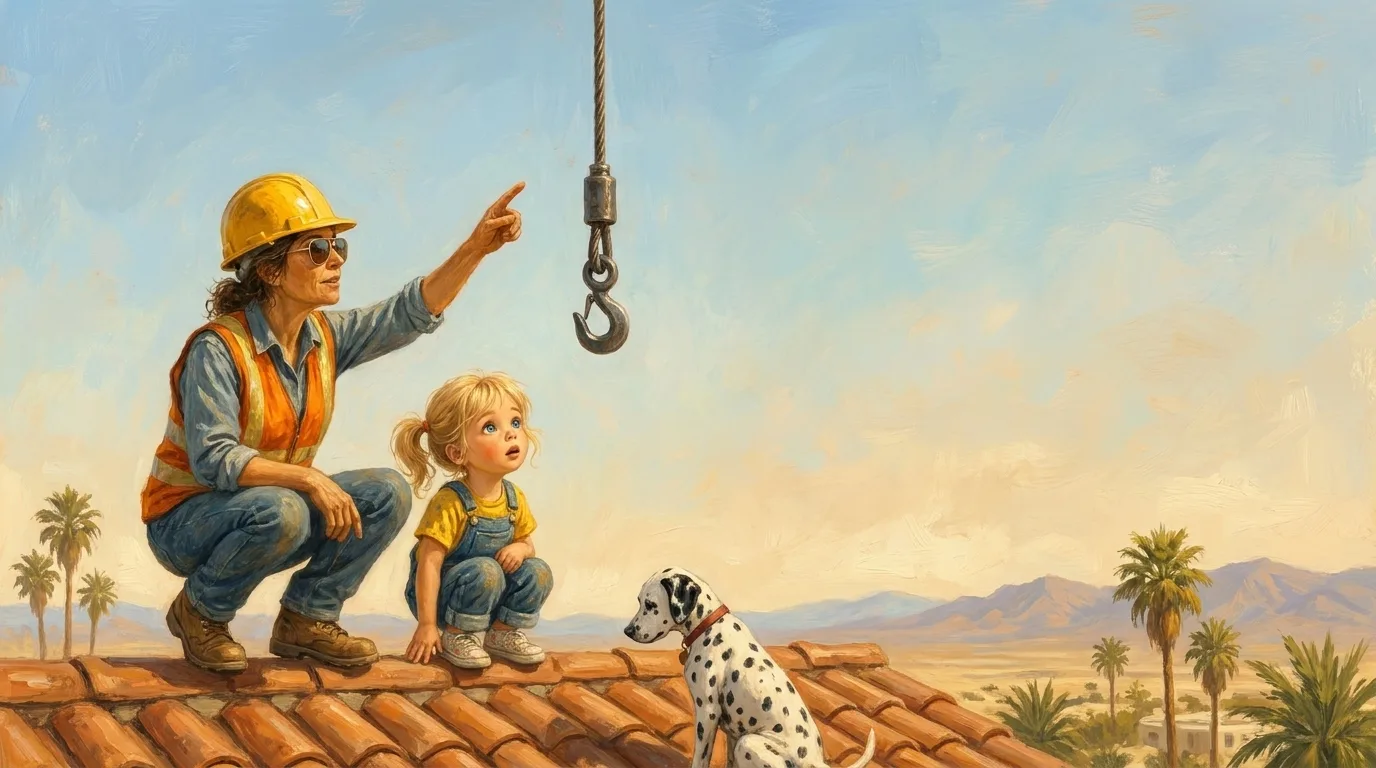
The crane operator crouched down, looked her in the eye, and changed how Hazel thought about slow.
It is 107° and still climbing. The dog has given up entirely. He is flat on the cool tile, one ear folded the wrong way, not even pretending to care. The old air conditioner is dead, the new one is on a truck somewhere down the road, and a little girl named Hazel is standing at the window trying to figure out how she can possibly help.
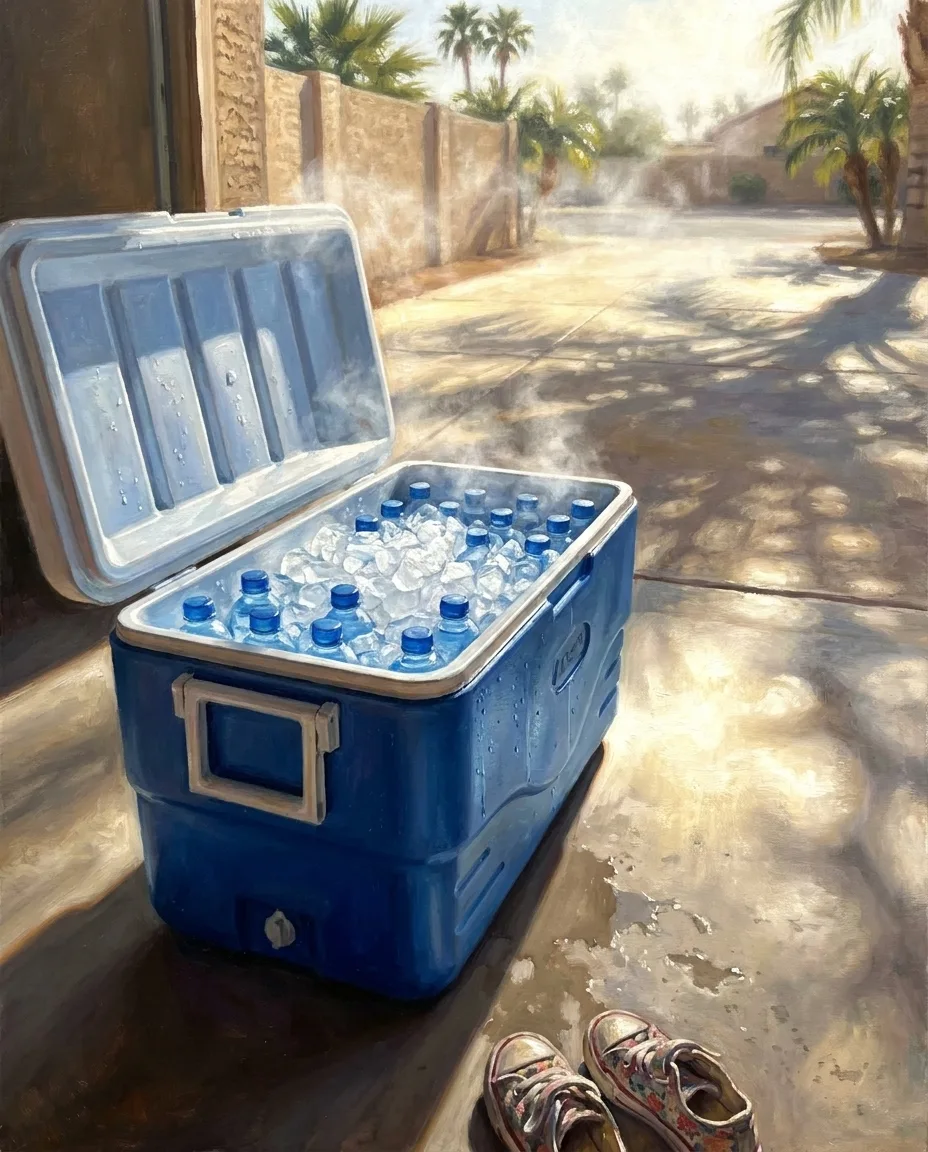
She can't lift the unit. She can't run the crane. She doesn't know what half the tools are called. So she does the one thing she can think of: she watches the cooler full of ice water her dad packed that morning, counting the bottles, willing them to stay cold.
That cooler, it turns out, is exactly where the story begins.
The book is Cool As Can Be: Hazel and the Air Lily Crew, written by Scott Rogers. It follows one desert morning from the first light when the crew arrives to the moment the new unit hums to life, and Hazel is there for all of it, asking questions most adults would feel embarrassed to ask.
What makes it different from the usual 'here is a lesson about gratitude' picture book is this: it never announces the lesson. The lesson arrives because Hazel does something real, watches something real, and has a grown-up take her seriously.
The scene that stops most readers is the crane. Not the machine exactly. The person running it.
Slow is a skill, not a delay
Crane operator Deb lays out her three rules for Hazel one at a time: never rush the load, never swing it wide, let the crane find its balance. The AC unit weighs more than Hazel's whole family. On a roof, there is no room for a wobble. Deb says it plainly: "Slow isn't lazy, little one. Slow is how you keep everybody safe." Hazel had always assumed fast meant good. She revises that assumption on the spot. So does the adult reading over her shoulder.
Slow isn't lazy, little one. Slow is how you keep everybody safe.
The most useful tool isn't on the truck
Hazel asks Asher, the lead worker, what the most important tool is. She figures it's the crane, or maybe the biggest wrench. He tells her it is neither. "Not the wrenches. Not the crane, even. Patience. Every single time." The book does not hammer this. It just lets it sit. A professional names an invisible thing as the real foundation of the job, and suddenly that invisible thing has a shape a child can hold.
Not the wrenches. Not the crane, even. Patience. Every single time.
Gratitude happens before the work starts
Before the crew even pulls into the driveway, Hazel's dad has packed a cooler with cold water bottles. He explains it this way: "It's a gift. For the crew. They'll be out in the heat all day, so we keep their water cold. That's how we say thank you before they even start." That one scene quietly dismantles the idea that thanks belong only at the end. A child who hears this line doesn't need a lecture about gratitude. She already has a picture.
Every job carries somebody's name
Asher tells Hazel that the company was founded by his grandmother Lily, who believed that "keeping a family cool on hot days is a way of loving them." He says she's on every roof with them. "Every single job. So she's always on the roof with us." A trade becomes a legacy. A service call becomes an act of care that traces back generations. That is a lot to land in two sentences, and the book lands it clean.
Every single job. So she's always on the roof with us.

Watching the cooler was the whole job
At the end of the day, Hazel worries she did nothing real. Asher sets her straight. "You kept an eye on this cooler all day long. That's not a small thing. A good crew needs somebody watching the water." Her worry was not helplessness. It was contribution. That is not a small distinction for a child, and honestly, it is not a small distinction for an adult either.
A good crew needs somebody watching the water.

Picture a Tuesday night in July. The AC is on. Your daughter hears the hum, looks up from her pillow, and says, 'That's like Hazel's house.' You close the book. She waves at the ceiling. You don't explain a thing about gratitude because you don't have to. She already feels it.
That is what this book is built to do. Not preach. Not explain. Just show a girl, a crew, a cooler full of ice, and a crane operator who crouches down and tells the truth about slow.
If that sounds like the kind of thing you've been looking for, head to the page below. It has everything you need to get your copy.
Preview this bookQuestions people actually ask
Is this actually a story, or is it an HVAC manual dressed up for kids?
It's a real story. Hazel is worried, she finds her own way to help, and the crew has a grandmother, a philosophy, and three rules passed down from her. The AC installation is the backdrop, not the point. The point is that slow, careful, loving work is behind every comfort we take for granted.
My kid has no interest in air conditioners. Why would this hold their attention?
Because Hazel isn't interested in air conditioners either. She's interested in the people, the enormous crane, a dog named Pepper who keeps flopping over in the heat, and whether the ice in the cooler is going to last the day. The equipment is just what the interesting people happen to be working on.
Won't this only land for kids in hot climates who've seen this kind of work?
The heat is vivid and specific. 110°, a dog flat on the tile, a driveway that shimmers. That specificity is what makes it land everywhere, not just in the desert. A child who has never seen a rooftop AC unit still knows what it feels like to be cared for by someone they've never met. That's what the book is really about.
I can find plenty of picture books about gratitude. What makes this one different?
Most of them tell the child what to feel. This one shows Hazel doing something real, watching the cooler, counting the bottles, worrying out loud, and then having a grown-up confirm that her worry was actually help. The gratitude isn't announced. It arrives on its own. That is harder to find.
Is it right for a wide age range, or will younger kids get lost in the technical bits?
Honest answer: the thermostat-as-traffic-light moment and Deb's crane rules are built for curious 6-to-8-year-olds who want real explanations. A 4-year-old will follow Hazel and Pepper and miss some of the middle. If your child is on the younger end, you'll be paraphrasing a few passages. That's not a flaw. That's a read-aloud.
Will it feel like the lesson is stapled on at the end?
That's the one thing the book works hardest to avoid. Nothing is announced. Asher doesn't wrap up with a speech. Hazel just sits in the cool air at the end of the day and thinks about who climbed a blazing roof so she could have it. The lesson isn't added. It's already in the room.