She didn't know how to say thank you. So she watched the water all day.
The AC goes out. It's already 110 degrees by nine in the morning. The dog is flat on the tile. And a crew of four people in sky-blue shirts is about to climb onto your blazing roof to fix it.
Most of us watch from inside. We feel bad about that, vaguely, and then we forget to feel bad because it's hot and the crew said not to worry.
That's exactly what I kept coming back to when I wrote this book. Not the broken unit. Not the repair. The gap between the people who do the work and the people who only ever feel the result.
Cool As Can Be: Hazel and the Air Lily Crew follows a little girl named Hazel through one long desert day as the Air Lily crew replaces her family's air conditioner. Hazel is not an HVAC prodigy. She is a kid who is worried about the workers, unsure what to do, and trying to figure out how she fits into a job she didn't ask to be part of.
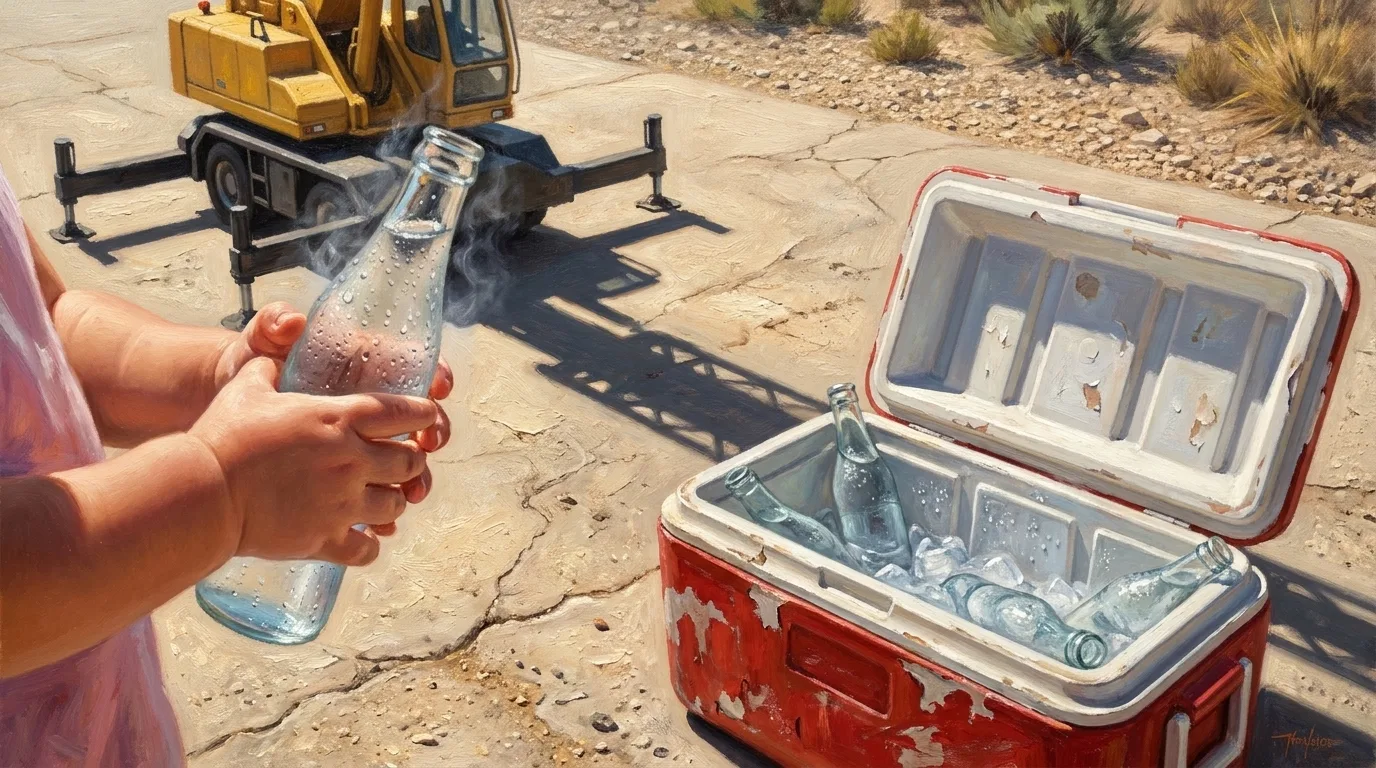
The book walks through the whole job: the crane, the cooler of water bottles her dad packed before the crew arrived, a lead worker named Asher who kneels down and answers every question, and a grandmother named Lily who founded the company on the belief that keeping a family cool is a way of loving them.
What I wanted was a story that earns its lesson instead of announcing it. A child who finishes this book should feel the gratitude, not just hear about it. And honestly, so should the adult reading alongside them.
Gratitude starts before the work does
Early in the book, Hazel's dad is already at the cooler, packing ice around water bottles before the Air Lily truck even turns the corner. He tells Hazel: "It's a gift. For the crew. They'll be out in the heat all day, so we keep their water cold. That's how we say thank you before they even start." That one scene does more for a child's understanding of gratitude than a week of chore charts. It shows that thanks is something you prepare, not something you remember to say afterward.
That's how we say thank you before they even start.

Slow is a skill, not a flaw
Crane operator Deb has three rules she repeats out loud every time she lifts a load: never rush the load, never swing it wide, let the crane find its balance. She tells Hazel, "Slow isn't lazy, little one. Slow is how you keep everybody safe." For any kid who has been told to hurry up a hundred times, watching a professional choose to go slow on purpose, as a point of discipline and pride, lands differently than a parent just saying 'be careful.'
Slow isn't lazy, little one. Slow is how you keep everybody safe.
The most useful tool is invisible
At one point Hazel asks Asher which tool on the truck he uses the most. She is expecting him to point at something. He doesn't. "Not the wrenches. Not the crane, even. Patience. Every single time." It is a short exchange, but children remember it because they weren't expecting it. Neither were most of the adults I've heard read it aloud. Naming patience as a tool changes how a child thinks about what competence actually looks like.
A worry can be a real contribution
Hazel spends most of the day hovering near the cooler, counting bottles, checking the ice. She thinks she is just anxious. At the end of the day Asher tells her: "You kept an eye on this cooler all day long. That's not a small thing. A good crew needs somebody watching the water." That moment is the emotional hinge of the whole book. A child who has ever felt useless at the edge of grown-up work will recognize it immediately.
A good crew needs somebody watching the water.
The hum in the ceiling has a name now
The last pages of the book give the reader something they carry out of the story with them. Hazel thinks about how most people feel the cool air and never wonder who climbed a blazing roof to give it to them. That thought, voiced by a child, is not preachy. It is just honest. And once a child has that thought, the AC hum in their own room sounds a little different on a hot Tuesday night.
Most people, Hazel guessed, wouldn't know any of that.

Cool As Can Be: Hazel and the Air Lily Crew is a picture book for children ages 4 to 8, written to be read aloud by an adult who wants the conversation to happen naturally, not as a homework assignment.
You don't have to explain gratitude when you close this book. Hazel does the explaining. You just have to read it out loud on a warm night when the AC is running and you both know, quietly, that someone worked hard in the heat to make that possible.
Find the book at the link below.
Preview this bookQuestions people actually ask
Is this actually a story, or is it an HVAC manual dressed up for kids?
It is a real story. Hazel is worried, she finds her own way to help, and the crew has a grandmother with a philosophy and three rules she passed down. The AC installation is the backdrop. The point is that slow, careful, loving work is behind every comfort we take for granted. The installation is just what the interesting people happen to be doing.
My kid has zero interest in air conditioners. Why would this hold their attention?
Because Hazel isn't interested in air conditioners either. She is interested in the people, the enormous crane, a dog named Pepper who keeps flopping over in the heat, and whether the ice in the cooler will last until the crew needs it. The equipment is just what the interesting people happen to be working on.
Won't this only land for kids who live somewhere hot?
The heat is specific, 110 degrees, a dog flat on the tile, a driveway that shimmers. That specificity is actually what makes it land everywhere, not just in the desert. A child who has never seen a rooftop AC unit still knows what it feels like to be cared for by someone they have never met. That is what the book is really about.
Is this appropriate for the full 4-to-8 range, or will younger kids get lost?
Honest answer: the thermostat-as-traffic-light moment and the crane rules are built for curious 6-to-8-year-olds who want real explanations. A 4-year-old will follow Hazel and Pepper and the ice and miss some of the middle. You will be paraphrasing a few passages for younger children. That is not a flaw in the book. That is a read-aloud.
I can find a dozen picture books about gratitude and hard work. What is different here?
Most of them tell the child what to feel. This one shows Hazel doing something real, watching the cooler, counting bottles, worrying out loud, and then has a grown-up confirm that her worry was actually help. The gratitude isn't announced. It arrives on its own. That is harder to find.
I'm tired of books with a lesson bolted on at the end. Is that what this is?
The lesson in this book is not on the last page. It is scattered across every scene from the moment Dad packs the cooler before the crew arrives. By the time you reach the end, the idea has already been building for twenty minutes. The last page doesn't announce anything. It just lets the room go quiet.