You're not behind on the tools. You're behind on the map — and those are two very different problems.
Every week, same Dunkin. Same two orders. Same plan: pull up the app in line, QR code ready before the scanner guy leans out. It never works. The app is still loading when the window opens. The scanner guy watches. He has the look — the one you give someone who reaches the front of the line and then starts searching for their wallet. Thirty seconds. Sometimes a full minute. Same store. Same stumble. Every single week.
That's not a phone problem. That's a reactive system doing exactly what reactive systems do: waiting for you to ask, then scrambling to answer. It's the same move software has been running for forty years. And it's the same move most of us have been running on AI. Something drops. We learn it. We master it. It moves. We chase the next one.
There's a quieter cost to that treadmill than most people admit. It's not panic. It's the low, grinding exhaustion of someone who has stayed curious, kept up, done the work — and still feels one announcement away from irrelevance.
Damon Nelson wrote The Anticipation Ladder: What AI Does Next, and What to Sell When It Does because he got tired of that feeling himself. Not the Dunkin fumble specifically. The larger one. The sense that staying current on the tools had become the entire strategy — and that the strategy had a leak in it.
The book's argument is simple and a little uncomfortable: the tools are already tied. The eight-dollar model handles most of what most people need. The arms race ended in a tie, and everybody got the weapons for eight bucks. 'Intelligence became a utility bill,' he writes. 'Nobody sends a press release when something becomes a utility bill. It just quietly stops being the interesting part.'
What becomes interesting instead is knowing where to point it. That's the shift the book is built around — from chasing capability to mapping the climb. The Anticipation Ladder is a four-rung framework (Reactive, Suggestive, Anticipatory, Delegated) that lets you locate any AI product, headline, or service offer on a single scale in about one second. And then, more usefully, sell something at each rung before the next wave breaks.

The plateau and the rocket are standing right next to each other
Prose quality has leveled off across the board. Excellent is now the floor, not the ceiling. Most people noticed that, felt relieved, and moved on. What they missed is that agentic capability — the ability to plan, pick up a twelve-step job, and carry all twelve steps through without stopping — is climbing fast in the other direction. The book is specific about this distinction because the two trends require completely different business responses. Staring at the plateau while the rocket takes off is how you get surprised.
The differentiator is not the engine. It's knowing where to install it.

A one-second filter for every AI headline that lands in your inbox
The four rungs: Reactive means you ask, it answers. Suggestive means it answers and then proposes your next move. Anticipatory means it prepares before you ask — the Dunkin app that has your order ready at 8:07 because that's what Tuesday looks like. Delegated means it asks if it should just handle it. Every product, every headline, every pitch from a vendor fits somewhere on that scale. Knowing the rung tells you what to sell, what to skip, and what's coming next. 'The rung a business sits on is a number you can charge money to change.'
Two reputation markets exist — most people can only see one of them
There is the market where AI quotes you to humans. And there is the market where AI recommends you to other AIs. The two lists overlap less than 20% of the time. Being number one on Google does not guarantee you a place in the AI answers. The book treats both markets as separate businesses requiring separate inputs, and Part Three has a specific, priced content service built around closing that gap for clients who don't know the gap is there yet.
There are now two reputation markets: one where AI quotes you to humans, and one where AI recommends you to other AIs. You can only see the first one.
Nobody ever wanted the training — they wanted the thing the training produces
Support agents built on rung four stop explaining how to do something and just do it. Handed a trustworthy button that says 'want me to handle this?', almost everyone says yes. The book calls this the biggest business story in Part Two — not because agents are new, but because the moment a client trusts the agent enough to press that button, the service underneath it becomes as sticky as electricity. 'Nobody ever wanted the training. They wanted the thing that the training produces.'
Nobody ever wanted the training. They wanted the thing that the training produces.

Dated predictions with a public scorecard the author grades live
Twenty predictions. Specific checkpoint dates in March 2027 and March 2028. A public scorecard where Nelson grades himself on the record. 'Forecasters who won't be graded are just entertainers.' That line is in the conclusion, and it's the reason the book reads differently from every AI strategy piece you've already forgotten. A dated map you can plan against is the opposite of the vague 'AI will change everything someday' content. The dates are the point.
The people who lose over the next eighteen months won't lose to AI. They'll lose to somebody who read the map earlier.
What readers are saying
"The whole 'intelligence became a utility bill' idea reframes everything. Once the engines are equal, the only things left that matter are your voice, your judgment, and your relationships. That feels true."
— Claire E."Prediction 3 saying good-enough intelligence gets cheaper than coffee by March 2028 already feels close. The eight-dollar tiers are handling most of what I need today. Access is no longer the product."
— Ashley R."The section on tools built on model gaps dying saved me from a bad idea I was about to build. Pride is not a market. That line stuck with me."
— Hannah G.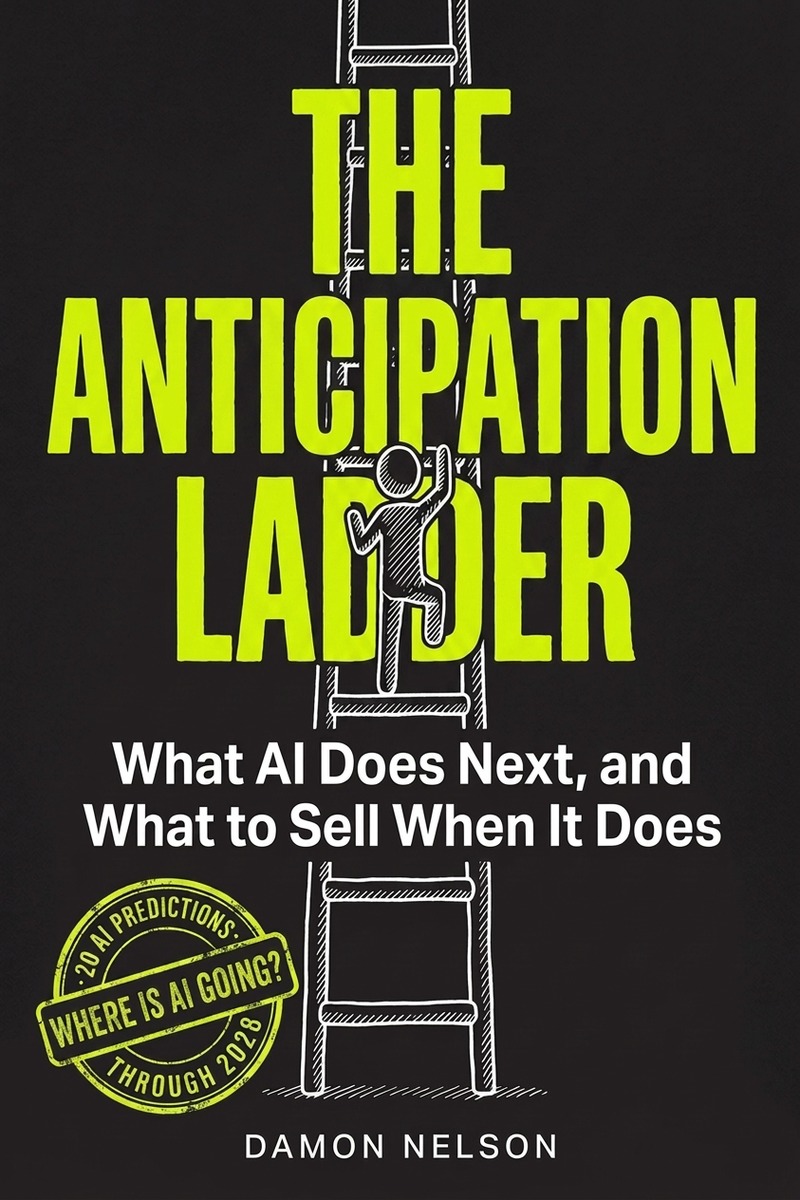
The Anticipation Ladder is an evening or two. The introduction stands alone. The predictions are built to be dog-eared. Part Three — the playbook — is nothing but priced, sequenced offers sized for a business of one: audits, agent installs, content retrofits, each matched to a specific rung and a specific checkpoint date.
When intelligence is a commodity, the only scarce inputs left are the ones that were always scarce: your voice, your opinions, your relationships. The book is built around turning those inputs into services you can sell before the next wave breaks. Not catch up. Get ahead. There's a difference, and three weeks from now you'll feel it.
You already know how to talk to clients. You already know which Tuesday-morning fumble is costing them. The map just tells you what to call it — and what to charge.
See It on AmazonQuestions people actually ask
By the time I read this, won't the predictions already be outdated?
Every prediction carries a specific checkpoint date — March 2027 and March 2028 — and a public scorecard Nelson grades on the record. A dated map you can plan against is the opposite of the vague 'AI will change everything someday' content that goes stale overnight. The dates are the mechanism, not a gimmick.
I've bought AI books before. They're all hype with no real playbook.
Part Three is nothing but priced, sequenced offers sized for a business of one — audits, agent installs, content retrofits — matched to specific predictions. The honest test: can you open it and build an offer before the first checkpoint date? If you can't, the public scorecard means you'll know exactly when the map failed. That accountability doesn't exist in the hype books.
I'm not technical. Can I actually sell AI services?
The book's core argument is that the technical edge is already gone — every shop runs the same engine for eight dollars. The scarce skill is knowing which client, which bottleneck, which specific fumble to point it at. That's a marketing skill. The playbook chapters teach that, not engineering.
My clients aren't asking for AI yet. Is there even a market for this?
Honestly, if your specific market is genuinely pre-awareness, some offers in Part Three won't land yet. That's the one objection the book concedes. What it helps you do instead is identify which rung your clients are on and lead with the outcome they already want — a phone answered, a support ticket closed, a morning brief ready — and let the AI stay invisible. Which, the book argues, is exactly how the winning products already work.
I don't have time for another business book right now.
The introduction is explicit: this costs an evening or two. The predictions stand alone and are designed to be dog-eared. You can go straight to Part Three and have a priced offer framework before you've read the whole thing. One evening is the ask, not a semester.
What if the predictions are just wrong?
Then the public scorecard will say so, in writing, on a deadline. 'Forecasters who won't be graded are just entertainers.' Nelson put that in the conclusion and built the whole book around it. Wrong predictions with public accountability are still more useful than right-sounding predictions with no dates attached.